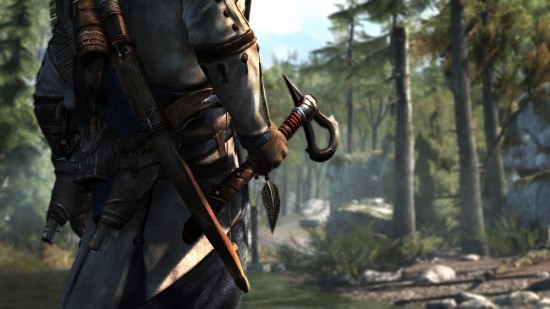
After three straight games following Ezio through the Renaissance, the Assassin’s Creed series moves on to a new and still somewhat unexpected timeframe of the American Revolution. Since the initial announcement of Assassin’s Creed III, the hype machine has turned out video preview after video preview to help bring back loyal assassins as well as recruit new ones to the franchise’s ranks. The result is one of the most anticipated titles of 2012 (coming out right before Halo 4 and Call of Duty: Black Ops II) which will most likely outsell its previous versions. But as we have seen in the past, just because a game has a triple A development budget and tons of marketing behind it, that doesn’t necessarily ensure it is going to live up to its potential.
The Long…
When I first stepped into Assassin’s Creed III, the first thing I noticed was how alive the world in front of me was. Being in a theater with hundreds of other guests made it feel like a real event going on around my character. It didn’t feel like just some instance created with a few background characters to fill up the space nor did it feel like the background of a sports game with a generic crowd with repetitive motions wallpapered in either. Instead it felt like my character was a part of a real and tactile world.
This feeling continues to hold true in many other areas of the game, especially the cities of Boston and New York. Constantly, you are surrounded by people all doing very different things. Some might be selling wares, others begging for coins and others just going about their daily business. What helps make this different though is the variety of animations and poses characters on screen go through as they go about their daily life. With a few exceptions (like the subway arrival in one of the game’s later present day scenes), you don’t often see two people on screen doing the same thing at the same time.